
Fighting illicit financial flows: key learnings from GI ACE research
This synthesis document presents insights from GI ACE research on the topic of illicit financial flows (IFFs).

This synthesis document presents insights from GI ACE research on the topic of illicit financial flows (IFFs).
Highlighting a disconnect between the UK’s ambition to be a global leader in the fight against corruption and illicit finance and its weak track record in confiscating assets derived from kleptocracy, a new research paper by Maria Nizzero, John Heathershaw and Tom Mayne argues that the UK must move away from seeing kleptocracy as a source of wealth problem and reframe it as a transnational enterprise. The authors propose a new legal conceptualisation of ‘kleptocratic enterprise’ as operating as networks structured in a similar way to those observed in organised criminal groups (OCGs).
Illicit finance continues to pose a significant threat to the integrity of Kenya’s real estate sector. Although Kenya has addressed gaps in its anti-money laundering and countering the financing of terrorism (AML/CFT) laws and deficiencies identified in the 2022 Eastern and Southern Africa Anti-Money Laundering Group (ESAAMLG) Mutual Evaluation, the system still struggles in practice. The Financial Action Task Force (FATF) grey‑listed Kenya in February 2024, citing serious deficiencies in its ability to prosecute money‑laundering offenses and weaknesses in its anti‑money laundering and counter‑terrorism financing regime.
The real estate sector remains a high-risk area for money laundering and terrorist financing due to pervasive use of cash, the involvement of politically exposed persons (PEPs), as well as weaknesses in the regulatory ecosystem.
Addressing these challenges could substantially strengthen the ability of the ecosystem to respond to illicit finance. Yet it will require practical, targeted reforms that go beyond tightening rules. Solutions should focus on making AML/CFT compliance workable for the real estate market as it functions in practice, and on enabling cooperation across ecosystem actors, including statutory bodies, industry associations, and civil society.

This report maps Kenya’s real estate ecosystem to understand how illicit finance enters the property market—an issue highlighted by Kenya’s 2024 FATF grey listing. It analyses five groups of actors (sellers, intermediaries, buyers, influencers, and rule-makers) and shows how weak oversight, low compliance, and political influence create significant vulnerabilities. Using case analysis, interviews and available data, the study identifies key illicit investors—including politically exposed persons, organised criminal networks, and regional actors—and highlights systemic gaps such as poor reporting by lawyers and real estate agents. The report provides a clear foundation for strengthening policy and regulatory responses to money laundering risks in Kenya’s real estate sector.

In 2022, Kenya underwent a Mutual Evaluation Review. The review report, along with the National Risk Assessment (NRA), identified significant vulnerabilities across several sectors, ultimately resulting in Kenya’s FATF grey-listing in 2024. The real estate sector was specifically flagged as high-risk. This briefing looks into the legal requirements for addressing money laundering in the real estate sector in Kenya.
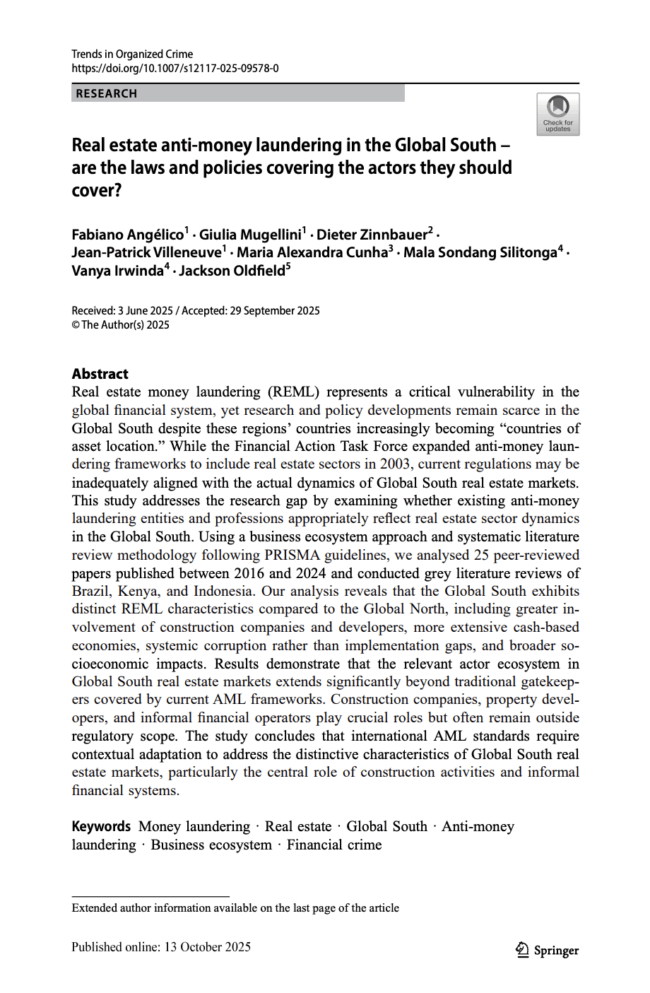
Real estate money laundering (REML) represents a critical vulnerability in the global financial system, yet research and policy developments remain scarce in the Global South despite these regions’ countries increasingly becoming “countries of asset location.” While the Financial Action Task Force expanded anti-money laundering frameworks to include real estate sectors in 2003, current regulations may be inadequately aligned with the actual dynamics of Global South real estate markets. This study addresses the research gap by examining whether existing anti-money laundering entities and professions appropriately reflect real estate sector dynamics in the Global South. Using a business ecosystem approach and systematic literature review methodology following PRISMA guidelines, we analysed 25 peer-reviewed papers published between 2016 and 2024 and conducted grey literature reviews of Brazil, Kenya, and Indonesia. Our analysis reveals that the Global South exhibits distinct REML characteristics compared to the Global North, including greater involvement of construction companies and developers, more extensive cash-based economies, systemic corruption rather than implementation gaps, and broader socioeconomic impacts. Results demonstrate that the relevant actor ecosystem in Global South real estate markets extends significantly beyond traditional gatekeepers covered by current AML frameworks. Construction companies, property developers, and informal financial operators play crucial roles but often remain outside regulatory scope. The study concludes that international AML standards require contextual adaptation to address the distinctive characteristics of Global South real estate markets, particularly the central role of construction activities and informal financial systems.
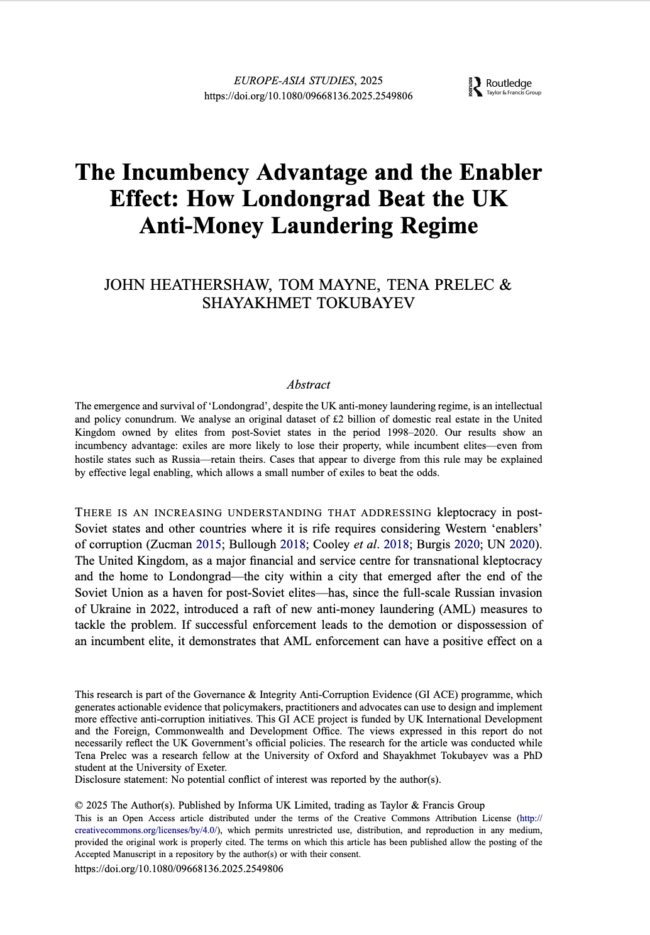
The emergence and survival of ‘Londongrad’, despite the UK anti-money laundering regime, is an intellectual and policy conundrum. We analyse an original dataset of £2 billion of domestic real estate in the United Kingdom owned by elites from post-Soviet states in the period 1998–2020. Our results show an incumbency advantage: exiles are more likely to lose their property, while incumbent elites—even from hostile states such as Russia—retain theirs. Cases that appear to diverge from this rule may be explained by effective legal enabling, which allows a small number of exiles to beat the odds.
The Centre for the Study of Corruption (CSC) has undertaken research on the issue of professional ethics in relation to the legal profession, and more specifically on solicitors in England & Wales. This has examined the role played by legal professionals in relation to kleptocracy, state capture and grand corruption. One conclusion of the research is that there are general principles pertinent to legal ethics, and particularly to client and matter take-on, that can be extrapolated from this research to other areas. The consultation response draws on GI ACE research to propose a regulatory guidance framework built around ethical standards and the primacy of the public interest.
GI ACE and Spotlight on Corruption released a landmark report presenting the findings of interdisciplinary academic research that explores the contested role of lawyers in relation to kleptocracy, state capture and grand corruption. Focusing on the role of solicitors in England and Wales, the research analyses the different narratives used to criticise and defend lawyers and law firms who act for the beneficiaries of kleptocratic wealth.