
Skip to content

The Centre for the Study of Corruption

X page opens in new windowLinkedin page opens in new window
Governance & Integrity Anti-Corruption Evidence
  • About
  • Our work
    • Research themes
      • Global finance and the enablers of corruption
        • Corruption in Paradise: An ecology of money laundering through real estate in the touristic global south
        • Identifying enabler networks and their vulnerabilities
        • Does transparency bring cleanliness? Offshore financial secrecy reform and corruption control
        • Hiding the beneficial owner and the proceeds of corruption
      • Crisis responses and corruption in vulnerable sectors
        • Addressing corruption in the crisis response of the Malawian health system
        • Crisis emergencies, state responses and ‘windows’ of corruption in Uganda
        • The corrupting effect of political connections in public procurement through crises
      • Corruption risks in global trade and commerce
        • Lessons for combating illicit cross-border trade and money laundering from the Congo
        • Interrogating corruption risk in the climate transition: Trading in voluntary carbon markets
        • International deal-making, beliefs, and local social norms
        • Ethical border trading between Kenya and Uganda for small-scale businesses
      • State capture
        • Building resilience to state capture
        • Resisting state capture from the grassroots: Civil society efforts and public perceptions
        • Building institutional resilience to global illicit financial flows as enablers and drivers of state capture
      • Sectors and Institutions
        • Fighting high-level corruption in Africa: Learning from effective law enforcement
        • Addressing bribery in the Tanzanian health sector: A behavioural approach
        • Detecting and deterring medication theft: A field study in health clinics in Malawi
        • Curbing corruption in procurement using ‘red flags’ risk indicators
      • Integrity systems
        • Cities of integrity: Urban planning and corruption in Africa
        • Can positive public recognition lead to good governance?
        • Harnessing informality: Designing anti-corruption network interventions and strategic use of legal instruments
        • Centralised versus decentralised monitoring to reduce corruption: Insights from comparisons across Indian state
        • Civil service reform and anti-corruption: Does ethics training reduce corruption in the civil service?
    • Fellowship
    • Rethinking Anti-Corruption
    • From Research to Practice
  • Resources
    • Publications
    • Blogs
    • Multimedia
    • Kickback – The Global AntiCorruption Podcast
  • News & events
    • Newsletter
    • GI ACE in the media
    • News from GI ACE
    • Upcoming Events
    • Previous Events
  • Contact
Search:
Search
  • About
  • Our work
    • Research themes
      • Global finance and the enablers of corruption
        • Corruption in Paradise: An ecology of money laundering through real estate in the touristic global south
        • Identifying enabler networks and their vulnerabilities
        • Does transparency bring cleanliness? Offshore financial secrecy reform and corruption control
        • Hiding the beneficial owner and the proceeds of corruption
      • Crisis responses and corruption in vulnerable sectors
        • Addressing corruption in the crisis response of the Malawian health system
        • Crisis emergencies, state responses and ‘windows’ of corruption in Uganda
        • The corrupting effect of political connections in public procurement through crises
      • Corruption risks in global trade and commerce
        • Lessons for combating illicit cross-border trade and money laundering from the Congo
        • Interrogating corruption risk in the climate transition: Trading in voluntary carbon markets
        • International deal-making, beliefs, and local social norms
        • Ethical border trading between Kenya and Uganda for small-scale businesses
      • State capture
        • Building resilience to state capture
        • Resisting state capture from the grassroots: Civil society efforts and public perceptions
        • Building institutional resilience to global illicit financial flows as enablers and drivers of state capture
      • Sectors and Institutions
        • Fighting high-level corruption in Africa: Learning from effective law enforcement
        • Addressing bribery in the Tanzanian health sector: A behavioural approach
        • Detecting and deterring medication theft: A field study in health clinics in Malawi
        • Curbing corruption in procurement using ‘red flags’ risk indicators
      • Integrity systems
        • Cities of integrity: Urban planning and corruption in Africa
        • Can positive public recognition lead to good governance?
        • Harnessing informality: Designing anti-corruption network interventions and strategic use of legal instruments
        • Centralised versus decentralised monitoring to reduce corruption: Insights from comparisons across Indian state
        • Civil service reform and anti-corruption: Does ethics training reduce corruption in the civil service?
    • Fellowship
    • Rethinking Anti-Corruption
    • From Research to Practice
  • Resources
    • Publications
    • Blogs
    • Multimedia
    • Kickback – The Global AntiCorruption Podcast
  • News & events
    • Newsletter
    • GI ACE in the media
    • News from GI ACE
    • Upcoming Events
    • Previous Events
  • Contact

Tag Archives: behavioural science

A healthcare professional wearing a light pink blouse and a stethoscope speaks with a patient in glasses and a green patterned top, seated indoors with a potted plant in the background.

Bribery, gift-giving and social norms: understanding corruption in the Tanzanian health sector

Baez Camargo, Integrity Systems, International ArchitectureBy GI ACE26/05/20201 Comment

GI ACE researcher Claudia Baez Camargo investigates the social norm of gift-giving in the Tanzanian health sector.

A dark blue digital network graphic showing glowing lines connecting circular icons, each containing a person silhouette, forming a web-like structure that represents online communities or data connections.

Social network interventions to tackle corruption

Baez Camargo, Integrity Systems, Subnational & SectoralBy GI ACE10/12/2019Leave a comment

GI-ACE project aiming to harness the power of social networks to promote positive anti-corruption outcomes among health providers and users through behavioral interventions and dissemination of interventions through trusted and influential social networks.

A network-style graphic overlays a cityscape of tall glass skyscrapers, showing glowing icons of people and email symbols connected by thin lines to represent digital communication and connectivity.

Harnessing Informality (Pt. 2): What could a network intervention to tackle anti-corruption look like?

Baez Camargo_ext, Integrity SystemsBy GI ACE04/12/2019Leave a comment

How might knowledge about the centrality of informal social networks be used to inform the design of innovative anti-corruption approaches?

A network-style graphic overlays a cityscape of tall glass skyscrapers, showing glowing icons of people and email symbols connected by thin lines to represent digital communication and connectivity.

Harnessing informality for anti-corruption practice: Shifting the unit of analysis from individuals to networks

Baez Camargo_ext, Integrity SystemsBy GI ACE22/10/2019Leave a comment

Researcher Claudia Baez Camargo writes about GI-ACE project, we adopt two perspectives to explore the question, “What would anti-corruption practice look like if we shift the unit of analysis from individuals to networks?”

A close-up view of several people seated and engaged in conversation, with the focus on their hands and expressive gestures. Soft natural light filters through a window in the background, highlighting the interaction and nonverbal communication between the group.

Working with social norms to develop effective anti-corruption interventions

Baez Camargo, Integrity Systems, Subnational & SectoralBy GI ACE04/09/2019Leave a comment

GI-ACE researcher Claudia Baez Camargo explores how we can diagnose whether there is a social norm that is underpinning observed behaviours.
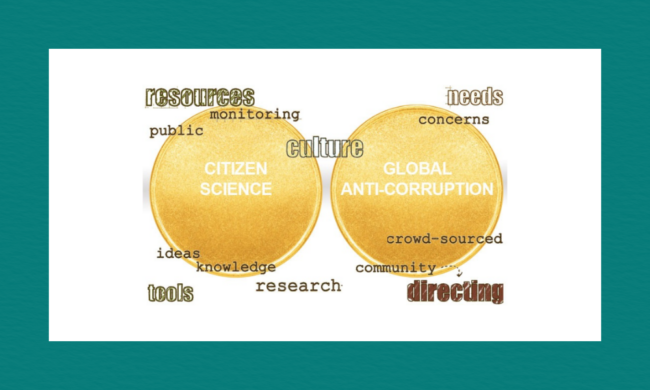
Two overlapping golden circles labeled “Citizen Science” and “Global Anti-Corruption,” surrounded by related words such as resources, monitoring, community, and crowd‑sourced. The shared space between the circles features the word “culture,” highlighting the connection between the two themes.

From citizen science to global anti-corruption: Two sides of the same coin

Chmura, International ArchitectureBy GI ACE27/08/2019Leave a comment

GI-ACE researcher Thorsten Chmura discussed focus of research on transnational corruption in international business, pushing the boundaries of citizen science.

Go to Top

GI ACE is funded by the UK government’s Foreign, Commonwealth & Development Office (FCDO) through its Global Research and Technology Development portfolio.

About

  • About
  • Our Team
  • Contact Us

Our Work

  • Research themes
  • Events

Resources

  • Blogs
  • Publications

Connect with us

If you've used any of GI ACE's research to inform policy and/or practice, let us know by sending an email at gi-ace@sussex.ac.uk. © 2026 GI ACE. All rights reserved. Hosted at the University of Sussex by the Centre for the Study of Corruption.