Tackling Corruption at the Sector Level
Sector-Based Action Against Corruption: A Guide for Organisations and Professionals is a book by Mark Pyman and Paul Heywood. It sets out their SFRA approach to tackling corruption, encompassing four…
State capture is an extremely harmful variant of corruption. Its distinctive and complex characteristics erode democratic institutions and norms, while concentrating power and influence in the hands of narrow interest…
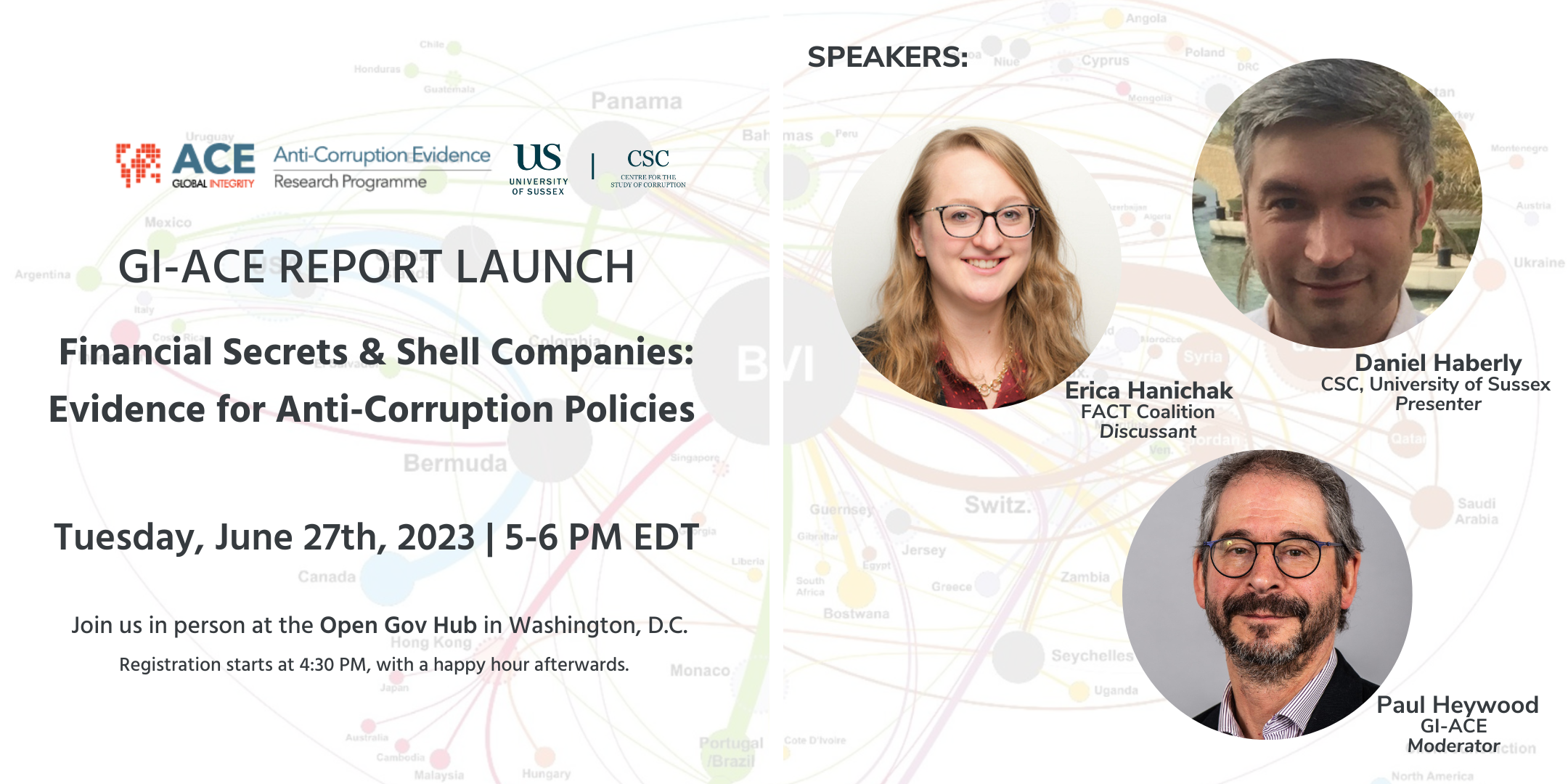
Join us for the launch of our most recent research report on global shell companies and offshore financial secrecy from the Global Integrity Anti-Corruption Evidence (GI-ACE) programme. The newly generated research uses big data analytics and global mapping to provide an important evidence base for anti-corruption policy-making in the future.
The GI-ACE programme has a number of projects looking at corruption in public procurement, government responses to crises, and how civil society can contribute to the contract monitoring processes that…
Video recording here The commodity trading sector has historically been vulnerable to multiple forms of corruption, including bribery, mispricing, embezzlement, and trade-based money laundering. Today, these longstanding risks are…
Video recording here In a 2020 report by the United Nations Conference on Trade and Development (UNCTAD), it was estimated that annual outflows of illicit finance from sub-Saharan Africa…
Video recording here Join us for a conversation on the relationship between state structures and organised crime in developing states on 16 September at 10:00 EDT, co-hosted by SOC-ACE,…
Video recording here A joint event on ‘Illicit financial flows and Russia’s foreign policy: Frameworks to detangle the dangers’ will be held on 15 June at 14:00 UK time,…
Register for this event now! Starting in November, each ACE research team will share how their research projects have aligned with the founding principles of the GI-ACE programme: developing anti-corruption interventions that are problem-focused, politically viable, have engaged practitioners throughout the research process, and provided avenues through which to measure the effects of the reforms. On March 3,…
Register for this event now! Starting in November, each ACE research team will share how their research projects have aligned with the founding principles of the GI-ACE programme: developing anti-corruption interventions that are problem-focused, politically viable, have engaged practitioners throughout the research process, and provided avenues through which to measure the effects of the reforms. On February 24,…
Register for this event now! Starting in November, each ACE research team will share how their research projects have aligned with the founding principles of the GI-ACE programme: developing anti-corruption interventions that are problem-focused, politically viable, have engaged practitioners throughout the research process, and provided avenues through which to measure the effects of the reforms. On February 3,…
Register for this event now! Starting in November, each ACE research team will share how their research projects have aligned with the founding principles of the GI-ACE programme: developing anti-corruption interventions that are problem-focused, politically viable, have engaged practitioners throughout the research process, and provided avenues through which to measure the effects of the reforms. On January 20,…
Register for this event now! Starting in November, each ACE research team will share how their research projects have aligned with the founding principles of the GI-ACE programme: developing anti-corruption interventions that are problem-focused, politically viable, have engaged practitioners throughout the research process, and provided avenues through which to measure the effects of the reforms. On February 10,…
Register for this event now! Starting in November, each ACE research team will share how their research projects have aligned with the founding principles of the GI-ACE programme: developing anti-corruption interventions that are problem-focused, politically viable, have engaged practitioners throughout the research process, and provided avenues through which to measure the effects of the reforms. On February 17,…
Register for this event now! Starting in November, each ACE research team will share how their research projects have aligned with the founding principles of the GI-ACE programme: developing anti-corruption interventions that are problem-focused, politically viable, have engaged practitioners throughout the research process, and provided avenues through which to measure the effects of the reforms. On January 27,…
Register for this event now! Starting in November, each ACE research team will share how their research projects have aligned with the founding principles of the GI-ACE programme: developing anti-corruption interventions that are problem-focused, politically viable, have engaged practitioners throughout the research process, and provided avenues through which to measure the effects of the reforms. On January 13,…
Register for this event now! Starting in November, each ACE research team will share how their research projects have aligned with the founding principles of the GI-ACE programme: developing anti-corruption interventions that are problem-focused, politically viable, have engaged practitioners throughout the research process, and provided avenues through which to measure the effects of the reforms. On December 16,…
This event launches a Chatham House paper of the same name. It details the laundering of monies and reputations by elites from Eurasia’s kleptocratic states, and the material and reputational damage rendered to the UK’s sovereignty and democracy. The UK’s financial and professional services have long provided a comfortable home to dirty money. The rapid…
Register for this event now! Corruption persists because it suits the interests of powerful players, and because anti-corruption initiatives often fail to unlock the political-economy drivers that hold corruption in place. Join the conversation! This session will focus on the value, and limits, of locally-led approaches to unlocking the complex challenge of corruption. The speakers will draw the…
Register for this event now! Starting in November, each ACE research team will share how their research projects have aligned with the founding principles of the GI-ACE programme: developing anti-corruption interventions that are problem-focused, politically viable, have engaged practitioners throughout the research process, and provided avenues through which to measure the effects of the reforms. On December 2,…
Register for this event now! Starting in November, each ACE research team will share how their research projects have aligned with the founding principles of the GI-ACE programme: developing anti-corruption interventions that are problem-focused, politically viable, have engaged practitioners throughout the research process, and provided avenues through which to measure the effects of the reforms. On November 18,…
Register for this event now! Starting in November, each ACE research team will share how their research projects have aligned with the founding principles of the GI-ACE programme: developing anti-corruption interventions that are problem-focused, politically viable, have engaged practitioners throughout the research process, and provided avenues through which to measure the effects of the reforms. On November 11,…
Register for this event now! Starting in November, each ACE research team will share how their research projects have aligned with the founding principles of the GI-ACE programme: developing anti-corruption interventions that are problem-focused, politically viable, have engaged practitioners throughout the research process, and provided avenues through which to measure the effects of the reforms. On November, 4,…
This discussion during the 2021 ICRN Conference is aimed at bridging the gap between investigative journalism and academia in the fight against corruption. The panel debate on the overarching theme: How can academia and journalism cooperate in disseminating knowledge about corruption?
The FCDO-funded Anti-Corruption Evidence programme works to deepen engagement practitioners and stakeholders have with research. Recently, Gerhard Anders and Matthew Page held private sessions in Nigeria and Malawi to present their research findings on what works and what doesn’t in law enforcement practice with senior policymakers and law enforcement officials. The event will focus on lessons learnt, best practices and the way forward for law enforcement tackling high-level corruption. This event will share how their research was received, with helpful advice on how to conduct and engage with policymakers.
The Cities of Integrity project at GI-ACE has developed a series of animated videos illustrating the specific issues of corruption in urban planning and its consequences for cities and their publics. These animations have been used in their workshops, social media, and direct engagement with particular groups such as early career planners. The screening will be followed by a panel discussion with the animators, the research team, and a representative from the Zambian Institute of Planners. We will discuss the advantages and limitations of using animated film in workshops and communications around integrity-strengthening as a response to corruption in planning. The Cities of Integrity team will reflect on their experience working with the production house in translating their research into accessible language and visuals and hone in on the question of impact together with the Zambian Institute of Planners as a key stakeholder.
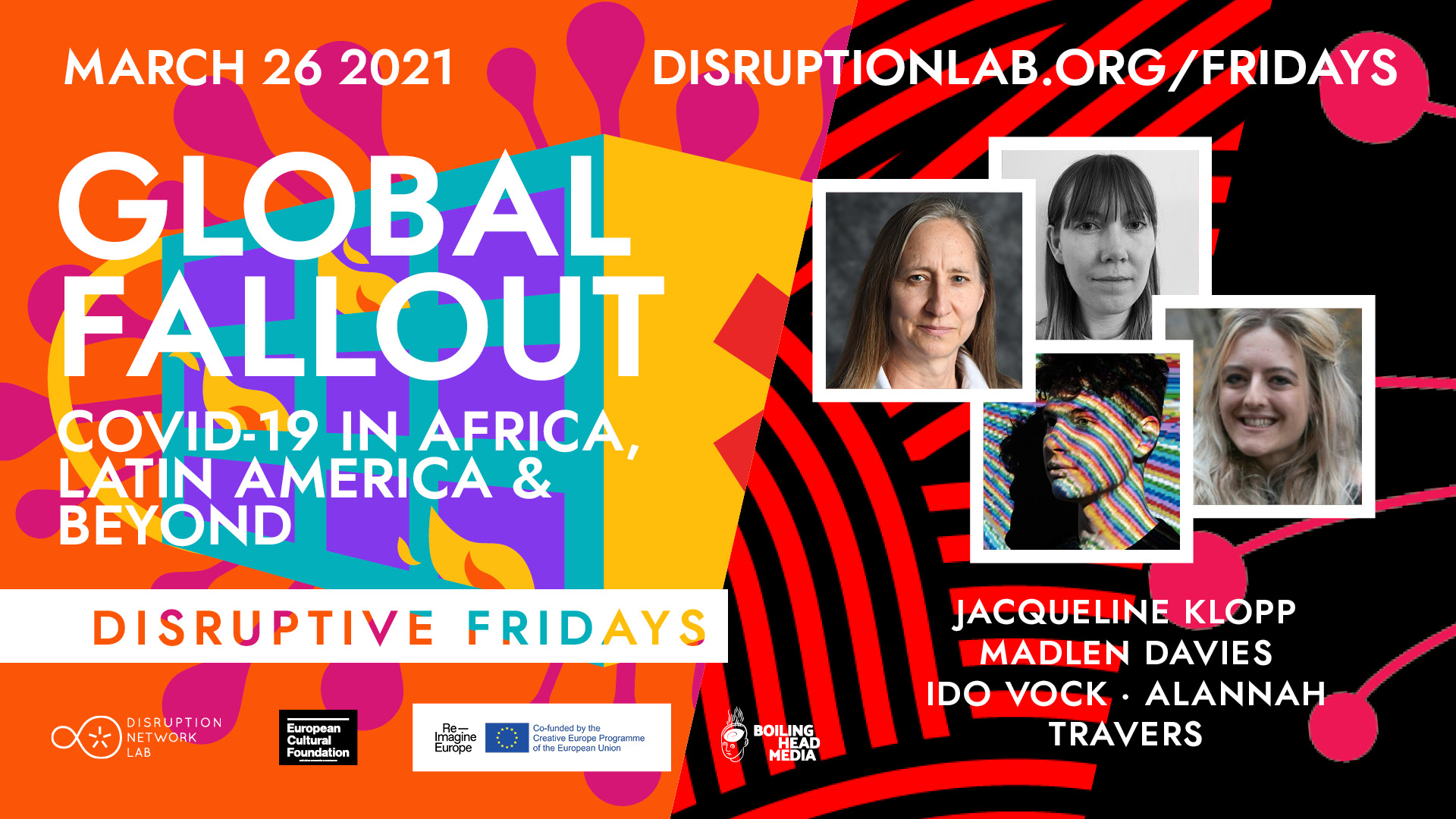
A Disruptive Fridays discussion with GI-ACE researcher Jacqueline Klopp, the New Statesman’s International Correspondent Ido Vock and UK-based investigative journalist Franz Wild hosted by the Disruption Network Lab.
Event time: March 26, 2021 12 EST
Register for the event here: http://gint.info/KloppDisruption
Crossing borders is a strategy used by many vulnerable populations in an age of inequality and climate crisis. Borders are governed by complex rules and bureaucracy that present ample opportunities for corruption, producing hardship and rights abuses that often have significant gender dimensions. Applying a gender lens, this conversation will draw on new research that looks at how COVID restrictions at borders are impacting small scale cross border traders in East Africa. What happened to bribery and harassment with Covid restrictions and how are these dynamics gendered? What can Covid impacts tell us about how corruption operates more generally at these borders and about strategies traders use to keep their businesses alive when facing shocks? As economic activities resume Post-Covid, what have we learned to improve trader conditions, build social resilience and reduce extraction from vulnerable populations at these borders?
Event time: March 25, 2021 8:00 EST
Register for the event here: http://gint.info/KloppOECD
There is a growing recognition that the enablers of large-scale (‘grand’) corruption lie in transnational financial networks. Literature suggests that a large proportion of illicit flows from Nigeria are invested in the UK. But illicit flows are, by their nature, illegal and deliberately hidden from view, making them a particularly challenging object of research. By presenting the findings of three Global Integrity Anti-Corruption Evidence (GI-ACE) projects that analyse UK-Nigeria business connections from different perspectives, this discussion will examine and problematise the international financial architecture that allows for proceeds of grand corruption looted from Nigeria to be laundered in the UK. It will furthermore discuss the role of Western professional service providers in facilitating kleptocratic practices.
Event time: March 24, 2021 15:00 GMT
Register for the event here: https://zoom.us/meeting/register/tJArcu2hpjgsEt0ATyUc8pqtZrsb2JW-w6yK
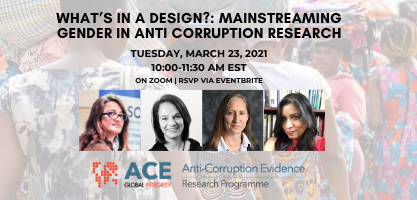
As part of FCDO’s Anti-Corruption Evidence Programme, SOAS and Global Integrity researchers will discuss why and how gender matters to our corruption research, both in terms of agency (how we focus on empowering actors) and impact (taking gender into consideration for public service delivery).
Our research teams will present challenges and opportunities they have faced in incorporating gender in research design, and explore why many researchers still stray away from working with “gender” when designing research. Does this difficulty stem from the fact that sectoral specificities with complex power imbalances make it difficult to focus on gendered dynamics and solutions? Or is that, despite the discussions and guidelines on gender mainstreaming, we still don’t have a shared understanding of the value of gender? Most important, are there things we are not studying that we might if we had a gender angle.
Event time: March 23, 2021 10:00 EST
Register for the event here: https://gint.info/GenderedDesigns